
Robert continues to see private clients. Private sessions are 3 hours and $300, focused primarily on common pain-related concerns, movement, and mobility rather than conventional relaxation massage. Appointments are arranged personally by text or email; there is no public online booking calendar.
Chronic pain can be complicated. When pain has been present for months or years, what you feel may be influenced by more than a single muscle, joint, or old injury. Movement, sensitivity, previous injuries, activity levels, stress, sleep, and the nervous system can all play a role in the pain experience.
My approach to chronic pain relief in Austin looks at the bigger picture. Rather than assuming there is one damaged or tight structure that needs to be “fixed,” I look at how you move, what increases or decreases your symptoms, and what helps you feel more comfortable. The goal is to find practical ways to improve movement, reduce sensitivity, and give you more options for managing your pain.
WHY CHRONIC PAIN CAN BE DIFFICULT TO SOLVE
WHY CHRONIC PAIN CAN BE DIFFICULT TO SOLVE
Chronic pain doesn’t always provide a simple map of what is happening in the body. Pain can persist even after tissues have healed, and the intensity of what someone feels doesn’t necessarily tell us how much physical damage is present. Movement, sensitivity, previous experiences, activity, stress, sleep, and the nervous system can all influence the pain experience.
That’s why I don’t assume that finding the painful spot means we’ve found the entire problem. I look at how your symptoms respond to touch, movement, positioning, and changes in surrounding areas. Those responses give us useful information and help guide what we do next.
MY APPROACH TO CHRONIC PAIN RELIEF IN AUSTIN
I don’t use the same routine for every person seeking chronic pain relief in Austin. I pay attention to how you move, what feels restricted, what increases or decreases your symptoms, and how different areas of your body respond to touch, movement, stretching, and positioning.
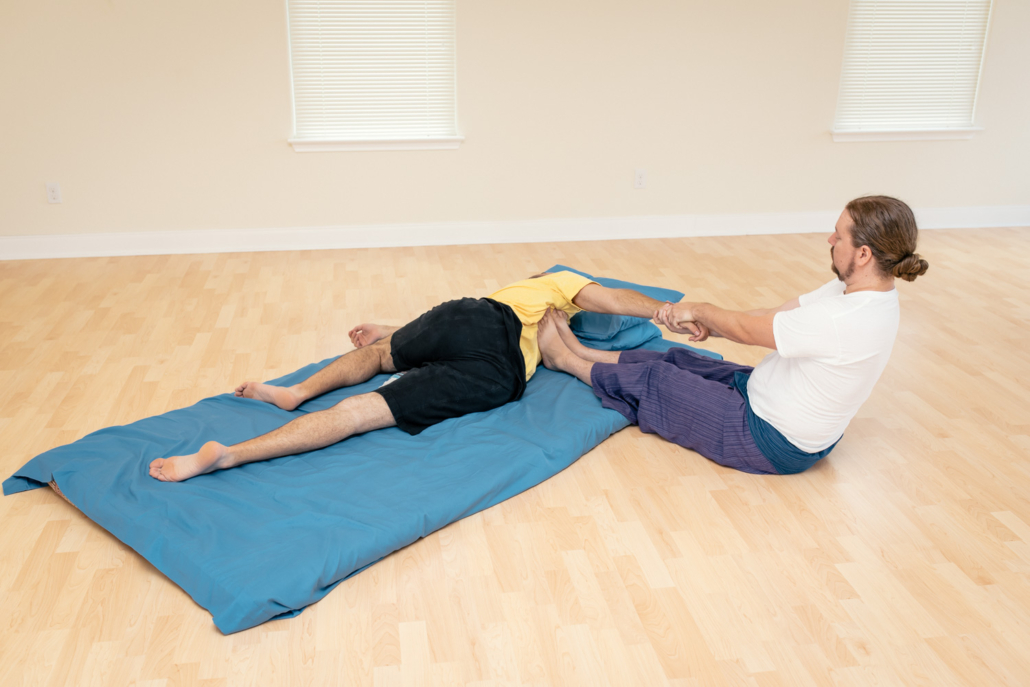
A session may combine targeted hands-on work, assisted stretching, movement, positioning, and self-care strategies. I’m less interested in forcing your body to change than in finding inputs that help you feel and move differently. The goal is to identify useful changes and give you practical options you can continue exploring outside of a session.
MY OWN EXPERIENCE WITH CHRONIC PAIN
My work with chronic pain is personal as well as professional. My own experience with persistent pain played a major role in shaping the way I work today. In many ways, my entire practice grew out of trying to understand pain, movement, and what actually helped when simple answers weren’t enough.
That experience is one reason I don’t approach chronic pain as a problem that can always be reduced to one tight muscle or one damaged structure. I know how frustrating it can be when pain persists and the explanations you’re given don’t seem to match what you’re experiencing. It led me to keep asking questions, experimenting with different approaches, and looking at the body more broadly.
That process eventually became the foundation of the work I do today: combining hands-on work, movement, stretching, self-care, and an evolving understanding of pain science to help people find practical ways to feel and move better.
WHAT A CHRONIC PAIN SESSION MAY INCLUDE
Because chronic pain can be complex, sessions aren’t built around a predetermined routine. Depending on what I find, we may work with the areas where you feel pain as well as other regions that influence how you move. Sessions can include hands-on pain relief work, assisted stretching, movement, positioning, and exploration of different ways to move more comfortably.
I also teach you things you can experiment with on your own. That may include simple movements, stretches, positioning, or self-care techniques. My goal is not to make you dependent on appointments—it’s to help you better understand your responses and develop more options for managing your pain in everyday life.
WHAT CAN CONTRIBUTE TO CHRONIC PAIN?
Chronic pain can be influenced by many overlapping factors. Previous injuries, changes in activity, limited or guarded movement, sleep, stress, fear of certain movements, and increased sensitivity in the nervous system can all affect how pain is experienced. Sometimes there is a clear structural problem, and sometimes the relationship between what someone feels and what can be seen on a scan is much less straightforward.
That’s why I don’t reduce chronic pain to a single explanation. I look at what changes your experience—movement, touch, positioning, stretching, activity, and other factors—and use those responses to help guide the work. I’m also comfortable saying when I don’t know why something helps. The goal is to find useful, repeatable changes rather than force every experience into one explanation.
IS THIS RIGHT FOR YOUR CHRONIC PAIN?
This approach may be a good fit if you’ve been dealing with persistent or recurring pain, especially when the problem has become more complicated than a single injury or painful area. You may have already tried multiple approaches, experienced periods of improvement and recurrence, or found that your symptoms change depending on movement, activity, stress, sleep, or other factors.
I work with people who want to better understand their pain and take an active role in finding ways to feel and move better. Chronic pain can also involve medical conditions that require appropriate evaluation and treatment, so this work is not a replacement for medical care when it’s needed. If you’re unsure whether your situation is appropriate for this type of work, you’re welcome to contact me before booking.
Learn more about my approach to pain relief and the different ways I work with clients.